Planning your next kite holiday in Tarifa? You are in the right place. Tarifa is one of Europe's best-known kitesurfing spots and offers a special mix of wind, long beaches, a relaxed atmosphere and a lively kite scene.
So that your trip is relaxed from the planning stage and not just on the water, we at Tarifa Surf Club have put together the most important information for you.
From the best time to travel and the right accommodation to a complete packing list: here is what really matters for a kite holiday in Tarifa.
The essentials in brief
- Season: you can kite in Tarifa all year round. Spring and autumn are the most pleasant for beginners.
- Wind: two winds shape the day, the steadier Poniente from the west and the strong, gusty Levante from the east.
- Getting there: the nearest airports are Gibraltar, Jerez and Málaga, about 45 minutes to just under 2 hours by car.
- Costs: a week with lessons comes to around €1,390 per person in our example, and a kite camp with accommodation starts at €599.
- Gear: everything is included in lessons. If you already ride, bring your own gear or rent it here.
Published by Tarifa Surf Club, kite school in Tarifa (Work Surf Balance GmbH) · Published on 11 November 2026
Why a kite holiday in Tarifa?
Tarifa sits at the southern tip of Spain, where the Atlantic meets the Mediterranean. Only about 14 km separate Europe from Africa here. The wind is squeezed through this strait, the Strait of Gibraltar, like through a nozzle. That is why it blows in Tarifa on a great many days of the year, though not every one of them is strong enough to kite.
Two winds shape the region: the Poniente from the west and the Levante from the east. Add miles of sandy beaches with different conditions, and Tarifa works for beginners, improvers and experienced kiters alike, as long as the spot and the day suit your level.
Off the water you have a lively old town, good restaurants, nature parks and day trips on your doorstep. Tarifa is worth it outside the main season too: the beaches are emptier and the climate stays mild. We teach here all year and are on the beach every day. What we write in this guide is what we tell our guests in person.
When is the best time to go?
You can kitesurf in Tarifa all year round. Which season suits you best depends on your level and on how busy you like it.
| Season | Temperatures | Typical wind | Crowds | Suits | Good to know |
|---|---|---|---|---|---|
| Spring (March–May) | mild to pleasantly warm, water still fresh | Poniente and Levante alternate | still relaxed | all levels | good time to learn, kite camps running |
| Summer (June–August) | warm to hot | often strong Levante for days | very busy | all levels, with the right spot | bathing season: kite zones on the beach are restricted |
| Autumn (September–November) | warm for a long time, warmest water | Poniente and Levante alternate | quieter from mid-September | all levels | good time to learn, kite camps start again |
| Winter (December–February) | mild but cooler; thicker wetsuit | sometimes strong, with rain fronts | very quiet | rather improvers and advanced riders | short days, not every weather pattern suits beginners |
Our tip: for your first kite holiday, spring and autumn are ideal. You get enough wind, pleasant temperatures and more space on the beach. Tarifa is busiest in July and August, and accommodation is at its most expensive.
Monthly averages for air and water, the windiest months and our wetsuit recommendation are on kitesurfing in Tarifa, together with live wind and the forecast.
Understanding Levante and Poniente
Which of the two winds is blowing decides the spot, the kite size and the plan for the day.
| Poniente | Levante | |
|---|---|---|
| Direction | from the west, off the Atlantic | from the east, off the Mediterranean |
| Character | often steadier, cooler and more humid | often strong and gusty, warm and dry |
| To the beach | onshore or side-onshore, depending on the spot | side-offshore to offshore, depending on the spot |
| What it means for you | good conditions for lessons and freeriding | smaller kites, more experience, rescue matters |
Offshore means the wind blows from the land out to sea. If something goes wrong, you drift away from the beach. That is why we teach with a rescue boat in Levante and choose the spot accordingly.
Important: no table replaces a look at the actual day. Conditions change daily and sometimes hourly. Read more about the wind conditions in Tarifa, where we explain both winds in detail.
Which kite spots suit your level?
There are several kite areas around Tarifa. A quick overview:
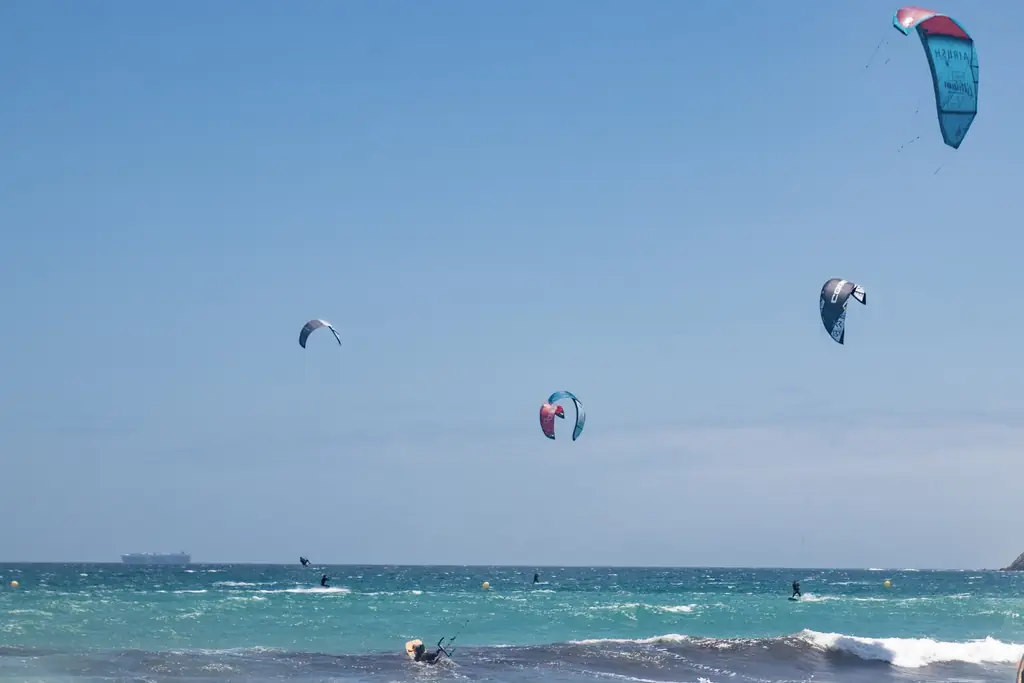
- Los Lances: the long town beach right in front of Tarifa. Wide, sandy and with plenty of space. Side-onshore in Poniente and, in the right conditions, good for beginners. Side-offshore in Levante, then only with rescue cover.
- Valdevaqueros: the bay in front of the big dune, just under 10 km to the north-west. Gusty and side-offshore in Levante, often the windiest spot in summer and very busy. Better for confident riders, with rocks at the southern end.
- Alternative spots: Palmones and Getares near Algeciras when the Levante is too strong in Tarifa, or Caños de Meca further north-west. You need a car for all of them.
Respect the kite zones: during the summer bathing season, kiting is only allowed in designated zones, which are marked with buoys and strictly enforced. Out of season the rules are more relaxed. Zones, times and access can change from year to year (overview at andalucia.com). Just ask us what currently applies.
All spots with wind direction and level are in our spot overview.
Lessons, kite camp or riding on your own?
- Beginners: book kitesurfing lessons. You learn safety, kite control, body drag and the water start, up to your first metres on the board. We teach privately (1:1) or semi-privately (2 students per instructor), in English, German or Spanish. All gear is included. How long it takes is explained in our guide to learning to kitesurf.
- Improvers: targeted training on your water start, riding upwind, safe turns and technique. A few private lessons often achieve more here than many days alone.
- Advanced riders: you ride independently, with your own gear or from our equipment rental. With Help 2 Kite we show you the right spot, stay nearby and bring you back by boat in offshore wind.
Important about Help 2 Kite: it is supervised kiting, not a lesson. You ride on your own responsibility, from around VDWS level 4–5. The rescue boat does not replace suitable wind conditions or sufficient riding skills either. What the levels mean is explained in our guide to the VDWS kite licence.
If you want everything from one source, book a kite camp: seven days with accommodation, lessons or Help 2 Kite and gear, from mid-September to mid-June. Here are our kite camps with accommodation.
Accommodation for your kite holiday
With accommodation, practicality matters more than luxury. What to look out for:
- Location: how far is it to the beach and to the old town? In Tarifa town you can walk to most things; the beaches towards Valdevaqueros need a car.
- Parking: spaces are scarce in the old town and in summer. A parking space at your accommodation is worth a lot.
- Gear: is there room to store kites and boards and to dry your wetsuit?
- Shopping: a supermarket and bakery nearby save you trips, especially without a car.
- Travelling together: with friends, an apartment with several bedrooms and a kitchen pays off.
We arrange four places to stay in Tarifa: the TSC Guest House, the Palomaview Penthouse with roof terrace, Casa Maresia and the Amara Apartment. All details and photos are under accommodation in Tarifa. In a kite camp, accommodation and kiting are already combined.
Getting to Tarifa
Tarifa has no airport of its own. Most guests fly to Málaga, Jerez or Gibraltar and drive the last stretch.
| Airport | Distance | Drive time | Good to know |
|---|---|---|---|
| Gibraltar (GIB) | approx. 45 km | approx. 45 min | the closest, but few connections. It has its own entry and border rules, so check before you travel. Queues at the border are possible. |
| Jerez (XRY) | approx. 130 km | approx. 1 h 15 min | small airport, relaxed handling, fewer flights depending on the season |
| Málaga (AGP) | approx. 155 km | approx. 1 h 45 min | most connections and hire cars, motorway partly tolled |
| Seville (SVQ) | approx. 215 km | approx. 2 h 15 min | an alternative if the flights suit you better |
Distances and drive times are approximate and depend on route and traffic.
Hire car: the most flexible option. Make sure your board bag fits in the car, and ask for folding seats if you bring your own gear. Transfer and bus: there are airport transfers and buses to Tarifa via Algeciras. It takes longer but works. Your own car: worthwhile mainly for longer stays or with a lot of gear.
Kite gear on the plane: register sports baggage with the airline in advance. Prices and size limits vary widely. Parking at the beaches: in summer the car parks fill up early and some charge a fee. Leave nothing visible in the car.
Do I need a hire car for a kite holiday in Tarifa?
Not necessarily. If you stay in Tarifa town and book lessons or a kite camp with us, you can manage without a car. We agree the meeting point with you. A hire car makes sense if you kite independently and want to change spots with the wind, if you stay outside town or if you plan day trips.
Your own kite gear or rental?
| Bring your own gear | Rent on site | |
|---|---|---|
| Advantages | familiar equipment, always available | less luggage, the right size for every day, advice on site |
| Costs | sports baggage both ways | daily rental, cheaper from day 4 |
| Kite sizes | you need several sizes, rather small ones in Tarifa | you take the size that suits today |
| Effort | transport, storage, a bigger car | pick up, ride, return |
| Suits you if | you stay longer and love your setup | you stay for a short time, want to try new gear or travel light |
Our equipment rental is open all year. Current sets, brands and prices are listed there. With Test & Buy you can try gear before you buy. Which kite size and board suit you is explained in our guide Which kite suits me?
As a beginner in lessons you need no gear of your own at all.
What does a week of kite holiday in Tarifa cost?
That depends heavily on the season, your accommodation and your level. The table shows three planning examples for seven days per person. The kiting items are our current prices. All other amounts are example values that you should replace with your own figures.
| Item | Beginner with lessons | Improver with Help 2 Kite | Advanced with own gear |
|---|---|---|---|
| Travel (flight, example) | €250 | €250 | €250 plus sports baggage |
| Accommodation, 6 nights (example) | €350 | €350 | €350 |
| Share of hire car or transfer (example) | €100 | €100 | €100 |
| Food and drink (example) | €200 | €200 | €200 |
| Kiting with us | €430 4 days of semi-private lessons incl. gear | €440 5 days of Help 2 Kite with rental gear | €140 5 days of Help 2 Kite without gear (optional) |
| Other (example) | €60 | €60 | €60 |
| Total (example) | approx. €1,390 | approx. €1,400 | approx. €1,100 |
Planning examples, not guaranteed prices. Flights, accommodation and hire cars vary widely by season. Our prices: as of November 2026, current figures under lessons and rental.
Money-saving tip: in a kite camp you get 6 nights of accommodation plus lessons or Help 2 Kite from €599 per person. The VDWS licence is an optional one-off €50 extra.
Budget calculator
Enter your own figures. Everything is calculated in your browser only.
Packing list for a kite holiday in Tarifa
What goes in your bag depends on how you travel:
- Beginners with booked lessons: you need no kite gear of your own. Kite, bar, board, harness, wetsuit, helmet and vest are included. Pack swimwear, sun protection, a towel and something warm for afterwards.
- Guests renting gear: you get kite, bar and board from us. Your own harness and wetsuit are nice to have if you own them. You can rent both too.
- Advanced riders with their own gear: you bring everything yourself, rather the smaller kite sizes for Tarifa. Plus a pump, repair kit and a well-padded board bag.
Often forgotten: waterproof sunscreen, a windbreaker and a jumper for the evenings. Even in summer the wind cools you down quickly on the beach.
The complete list with documents, gear, clothing and tech is below as an interactive checklist that adapts to your level. To print it, use the PDF checklist.
What to do when there is no wind?
Windless days are part of Tarifa too. You will not be bored:
- Old town: stroll through the white lanes, have a coffee, eat tapas in the evening.
- Day trips: the Roman ruins and the dune at Bolonia, Vejer de la Frontera, Cádiz or Gibraltar.
- Nature: hiking and cycling in the nature park, long beach walks, whale and dolphin watching in the strait.
- On the water: surfing when there is swell or SUP on calm days, wherever it is allowed and safe.
- Gear care: check your lines, have small damage repaired, rinse your wetsuit.
Our personal favourite places, from breakfast to sunset, are in the Tarifa guest guide.
What to do in Tarifa when there is no wind? Discover our alternatives to kitesurfing.
Safety when kitesurfing in Tarifa
Tarifa is a demanding spot. A few basic rules keep your holiday relaxed:
- Assess conditions honestly: do wind strength, gusts and direction suit your skills and kite size? If in doubt, stay ashore.
- Offshore wind: do not go out in offshore wind without organised rescue cover.
- Gear check: check lines, canopy and valves before every session. Trigger the quick release once and reassemble it.
- Kite zones and distance: stick to the designated zones and right-of-way rules. Keep your distance from swimmers, windsurfers and other kiters.
- Launching and landing: always with help and with enough space downwind.
- Never alone: tell someone on land before you go out.
Local rules and conditions change. Ask at the station what applies on the day. Liability insurance that covers kitesurfing makes sense, for example through the VDWS SafetyTool. If you enter our school number 26899 when signing up, we can help you with a claim. The emergency number in Spain is 112.
Perfect planning, step by step
- 6–8 weeks before: fix your dates, compare flights and accommodation, ask about lessons or a kite camp, check your insurance.
- 2–4 weeks before: check your bookings, sort out the hire car or transfer, register sports baggage, check your equipment.
- 1 week before: prepare documents, go through the packing list, save contact details, look at the wind and weather forecast.
- On arrival day: check in, organise your gear, get in touch with us and agree the first day.
- Before every session: check wind and weather, clarify the spot rules, check gear and safety system, assess your own skills realistically and think about getting back to shore.
You can tick off every point in the checklist.